


Stubbornness and Resilience Are Separated by a Thin Line—and the West Might Never Know That Difference

I was walking through my favourite Chinese supermarket, scanning shelves for what was new and what had quietly disappeared. And there it was: Lao Gan Ma, shining in its familiar jar, glistening with an almost unearned grandeur.
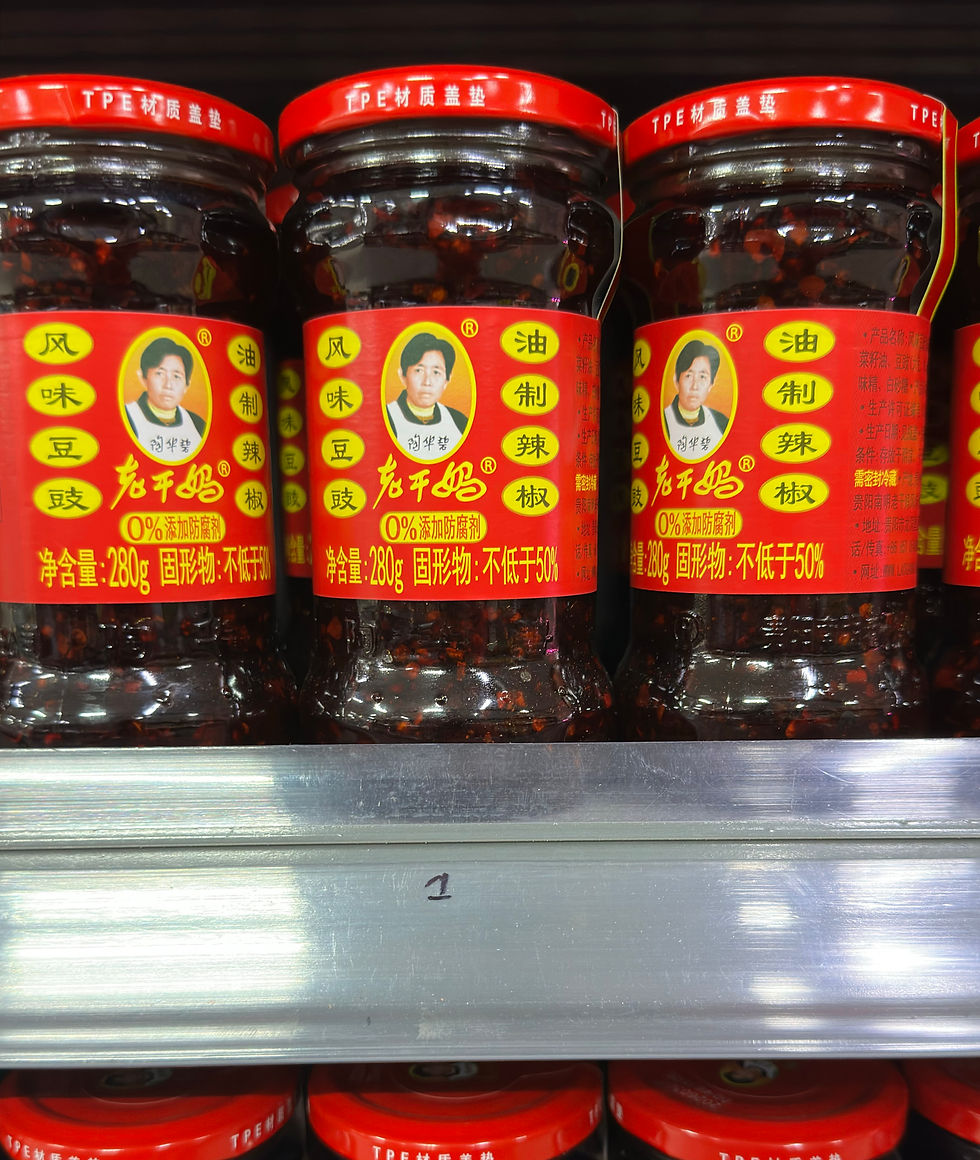
If you haven't encountered it, Lao Gan Ma is one of China’s best-known and most widely recognized chili-oil brands. A condiment so culturally embedded that (anecdotally) Chinese students pack it in suitcases to foreign dorms, and expats pay more just to taste home.
The name Lao Gan Ma is often translated as ‘Old Godmother,’ in English.
But she didn't start out selling chili oil. She ran a noodle shop. The brand was created by Tao Huabi (陶华碧), (in widely repeated accounts) who started in 1989 with a small noodle shop in Guiyang, Guizhou province.
Some accounts say customers preferred the sauce to the noodles; others describe sauce production developing gradually. Her homemade chili sauce became so popular that she shifted to making it full-time. Commercial production began around 1996, while the company is generally dated to 1997.
Her story is often called “inspiring,” because we all love a “famed underdog wins the race” story, but the one thing that struck me was the tenacity through tension. What I've come to understand is that there is this thin beautiful line between resilience and stubbornness.
A koi fish swimming upstream is resilient. Even though it has no choice; the current is life itself. Yet a human who refuses to change is called stubborn.
The West, I've noticed, has a peculiar logic: pioneering only works if you do it like everyone else; scale fast, cut costs, optimize for exit, make it easy for stakeholders to move on from you. If you refuse that logic, you’re just stubborn, as stubborn as an ox.
But she also had a very culturally integrated product so her stubbornness actually paid off. What she built for her business might not work for everyone. So, this is not an article on how you can build your own hot chilli oil empire. But rather, looking beyond my own (and probably your own) cultural assumptions to see how entrepreneurs in other contexts have built businesses pre-social media era.
Furthermore I’m not Chinese but just out of my curiosity for Chinese culture I found out about Lao Gan Ma. It’s just that good enough to make me want to try.
I cannot think of a single condiment brand like Lao Gan Ma that has reached peak cultural and culinary relevance. I can only think of Tabasco and Heinz—but outside of these brands, I genuinely cannot name a single single-product condiment brand that has achieved the cultural ubiquity of Lao Gan Ma.
Very few condiment brands, in my view, have achieved a comparable combination of recognition and emotional attachment. Note: Lao Gan Ma's ownership has changed within the family. Tao handed management to her sons, later returned to an active role, however reports indicate that she and one son were no longer shareholders at one point. I am not saying that there aren't popular condiment brands outselling shelves. Because I know a lot of people like to miss the point when perspective is the topic at hand. Every country has that one popular condiment people cannot live without. But many condiments disappear before our generations can even taste the goodness of actual taste. So this is not (just) about creating a global product but a product that people are proud of using so much so that even when they’re not home, they want it with them. After all, Recent China Daily reporting attributes this figure to Xinhua and says exports represent roughly 10% of sales. How many brands can actually build such a brand? With the recent technology advancements, entrepreneurs are more interested in how fast they can scale vs how great their product can be without any gimmicks. And there are many reasons why brands don't build like Tao Huabi anymore... most of these reasons are rooted in impatience. Gimmicks are faster than greatness. It might take 4-10 years to perfect a chili blend. But it takes perhaps less than 10 days to launch a viral TikTok campaign. Entrepreneurs choose the latter because many investors (the market included) reward velocity, not viscosity (stickiness).
Founders don't trust their own taste as much as they used to. From my research, specific accounts emphasize that Tao prioritised direct customer response more compared to formal market research. She made what she loved and assumed others would too. That's radical self-trust. Most founders second-guess themselves into mediocrity. Many founders focus on pivoting and leaning towards what works economically and that's fair. But they also forget that what you’re good at and what the market demands are not mutually exclusive but people don’t often pay attention to both their gifts and business long enough to figure out where the intersection is. I believe Tao Huabi understood that the intersection isn't a one-time discovery; but rather a muscle you have to keep returning to. And she essentially taught me to ask myself: "Am I still the best in the world at this one thing? Does the market still want this from ME?"
"Good enough" kills "unforgettable." When you scale too fast, you standardize. When you standardize, you flatten flavor. We see this from her insistence on preserving the flavor associated with Guizhou peppers to her reported rejection of substandard product. That inefficiency is intentional because it's the cost of being irreplaceable.
Of course, Tao Huabi had the concept of time on her side, anyone older than 35 might be thinking "Sami, nice thought but I personally don't have all that time to build and scale..."
And that's a fair observation because we don't really know how much time we have left anyway. But still, will you rush to build a house with a shaky foundation because we don't have much time?
I don't think so. A great product is so important, even more important than your packaging and social media marketing. Everything else comes after the product. And I don't think she ever needed a trendy campaign to sell. Her product was her marketing. Every jar that left her factory was an ad and a free one at that, because people showed it to each other. And of course, distinctive flavor and word of mouth matter, but I'm not naive enough to overrule the power of distribution, pricing, retail access, and later social media exposure. Still, a product has to be well received for every other headache to make sense. How many businesses fail simply because they didn't stay at their intersection long enough for the market to fully reward them? I think that is one difference I have observed between some Western and Eastern entrepreneurial environments. In the West, speed is often rewarded, even when it means setting the entire highway on fire. In many of the Eastern entrepreneurial circles I have observed; capability, tenacity and endurance (I call it endurance through awareness) go hand in hand and they’re more rewarding than going fast alone. Of course, efficiency is still a leading factor. To most of my Chinese acquaintances who happen to be entrepreneurs, suffering is a virtue. They believe that suffering produces a much stronger character. The kind of character that has the patience to suffer through slow growth, to refine a product through countless small failures, and to trust that the market will eventually recognize true quality. It is the necessary kind of suffering that earns you a place in the world. I might not share the exact sentiments, however I do agree to some extent that suffering produces grit. I believe Tao Huabi embodies this philosophy very well. From the way she dries her chillies to sticking to her beliefs that shaped her success. This is reflected in reports that she later ordered roughly 500 tons of product destroyed after a batch reportedly failed to meet the expected flavor standard... I interpret that decision as evidence that she was unwilling to sell a product she believed failed her quality standard.
Yes, after management substituted lower-cost peppers, reportedly from Henan, the brand faced criticism over a perceived change in flavor.
What was deemed economically smart turned into a nightmare simply because management thought cheaper peppers = higher margins. They forgot that the tiniest detail; such as "making sauce with Guizhou peppers" is what makes a product truly unique.
Very much like the management, the west is always running away from suffering in the name of convenience. And because of this, we miss very important lessons that build strong brands. For example, we protect revenue more than we protect trust, forgetting that revenue can be lost in this quarter and recovered in the next however trust takes decades to build and seconds to destroy. This is not a critique at what form of capitalism is the best, I just hope to see this generation of entrepreneurs thinking differently, even if it means looking outside our culture to borrow lessons from time. It would be really cool to speak to Tao Huabi one day. I feel like I'll unlock a new level of perspective. Because Lao Gan Ma illustrates how a narrow product promise, repeated consistently over time, can become an emotional asset and how cost-cutting that damages the product can threaten the trust built around it. It all boils down to one thing: your character shapes what and how you build.
A business, like any other relationship, is often praised for its successes. I don't know what kind of hell Lao Gan Ma as a collective had to endure, or what kind of mistakes they have made. But who hasn't made mistakes? It is rather admirable to see a brand go back to their "why" — so that we can learn from them. Disclaimer: This is not legal advice. This is not financial advice. This is not even cooking advice. This is just one person standing in a supermarket aisle, having thoughts. Lao Gan Ma, Heinz, and Tabasco are all real brands that exist in the world. I am a real person who exists in the world. We have never met and none of these brands know my name. I would like to meet Tao Huabi and I do not mind receiving free chilli oil for the rest of my life. That is all.
Sources & Further Reading
Lao Gan Ma Official Website. "About." https://en.laoganma.com.cn
Xinhua News. "Profile: Chinese village woman committed to making renowned chili sauce." March 8, 2023.
China.org.cn / Xinhua. "Iconic Chinese chili sauce resonates with diverse appetites." January 16, 2026.
上观新闻 / 新民晚报. "老干妈创始人出山救子." January 12, 2026.
新浪财经 / 顶端新闻. "老干妈为河南辣椒'正名'." January 30, 2026.


Comments